
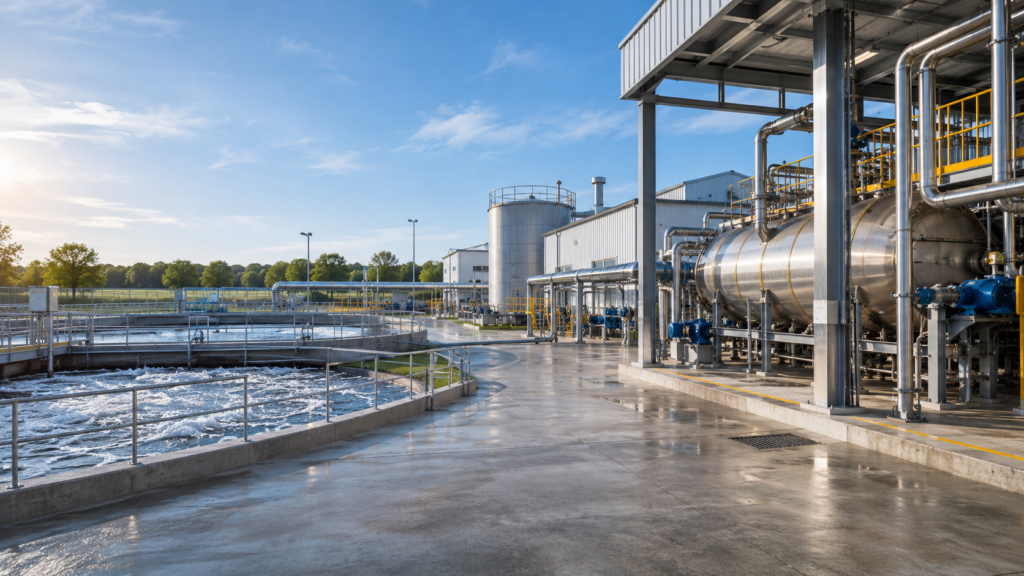
Rendering wastewater treatment. Built for demanding conditions.
Rendering plants need membrane filtration that keeps pace with production. BLUE FOOT's IPC® ultrafiltration membranes deliver reliable solids separation in industrial MBR systems. Reinforced construction, true permeate backwashing and high membrane capacity make IPC® a strong choice for new installations and space-constrained plant upgrades.
What makes rendering wastewater difficult to treat?
Fats, organics and nitrogen.
Rendering wastewater often contains elevated organic and nitrogen loads alongside fats, oils and grease. Effective pretreatment and biological treatment are essential to manage these loads within an MBR process.
Capacity that keeps pace.
As production grows, wastewater volumes rise. Existing treatment plants need additional capacity while maintaining consistent operation.
More capacity. Limited space.
Established rendering facilities often have little room for expansion. Plant upgrades must fit within the available footprint and integrate with existing infrastructure.
More membrane capacity. Designed around existing infrastructure.
Expanding wastewater treatment doesn't always mean expanding the footprint. IPC® Flex modules provide high membrane area in compact configurations, giving engineers the flexibility to increase membrane treatment capacity within existing infrastructure. BLUE FOOT brings the membrane expertise needed to match the configuration to each project.
RENDERING PROJECT · BELGIUM
Rendac.
Part of Darling Ingredients
Capacity expansion within an existing plant.
At Rendac in Denderleeuw, Pantarein integrated BLUE FOOT's IPC® membrane technology into an existing biological wastewater treatment plant. The phased upgrade increased membrane treatment capacity while working within the available site space.
Read the Rendac case studyPlanning a rendering wastewater project? Let's get the membrane configuration right.
Expanding an existing plant or designing a new MBR system? We bring the membrane expertise to assess your operating conditions, capacity targets and integration requirements.