
Membrane Bioreactor (MBR)
A membrane bioreactor combines biological wastewater treatment with membrane filtration. Microorganisms break down pollutants, while membranes separate treated water from biomass and suspended solids. The result is a compact treatment process delivering consistently high-quality effluent, even where discharge requirements are stringent or space is limited.
How does a membrane bioreactor work?
An MBR combines biological wastewater treatment with membrane filtration. Instead of relying on a secondary clarifier to separate sludge from treated water, membranes provide a physical barrier that retains biomass and suspended solids.
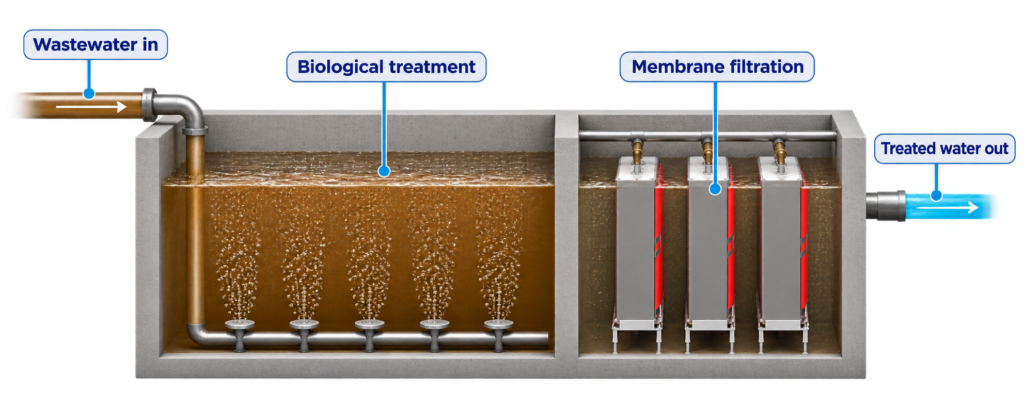
Biological treatment
Microorganisms break down organic pollutants in the wastewater through biological treatment.
Membrane filtration
Ultrafiltration membranes retain biomass and suspended solids while treated water passes through.
Treated effluent
Filtered water leaves the membrane system, ready for discharge or further treatment, depending on the application.
Why choose MBR technology?
By combining biological treatment with membrane filtration, MBR technology offers an alternative to conventional activated sludge systems, particularly where effluent quality, treatment capacity and available space are important.
Consistent effluent quality
Membrane filtration provides reliable separation of biomass and suspended solids, even when sludge settling characteristics vary.
Compact footprint
By eliminating the need for conventional secondary clarifiers and allowing higher biomass concentrations, MBR can reduce the space required for treatment.
Higher treatment capacity
Higher mixed liquor suspended solids concentrations can support increased biological treatment capacity within existing space constraints.
Water reuse potential
High-quality MBR effluent can provide a suitable starting point for further treatment and water reuse, depending on the application.
Submerged vs. side-stream MBR.
Membrane bioreactors can be configured in different ways, depending on the application, available space and operational requirements. The main distinction is where the membranes are installed and how wastewater flows through the filtration system.
Submerged MBR
Our IPC® membranes are engineered for submerged MBR applications.
In a submerged MBR, membrane modules are immersed directly in the biological reactor or installed in a separate membrane tank. Filtration typically operates under suction, while aeration helps control membrane fouling.
Explore our modular technology →Side-stream MBR
In a side-stream MBR, membranes are installed outside the biological reactor. Mixed liquor is circulated through an external filtration loop, typically using pumps. This configuration allows the filtration system to be accessed separately, but often involves higher circulation energy requirements.
Ready to rethink wastewater treatment?
Whether you're planning a new MBR installation or upgrading an existing wastewater treatment plant, let's explore how BLUE FOOT's IPC® membrane technology can support your project.