Decentralised water solutions: From concept to scalable reality
As water demand continues to
rise and infrastructure constraints become more evident, the limitations of traditional centralised treatment systems are increasingly exposed.
Expanding large-scale facilities is often slow, capital-intensive and inflexible, particularly in regions experiencing rapid industrialisation or space constraints.
Decentralised water solutions offer a practical alternative. By treating water closer to the point of use, they enable faster deployment, greater flexibility and reduced reliance on extensive infrastructure. This makes them especially suitable for industrial sites, remote locations and urban areas where additional capacity is required quickly.
However, decentralisation is not
simply a matter of downsizing
treatment systems. To be viable
at scale, these solutions must
deliver consistent performance,
operational reliability and ease of implementation. Historically, this has been challenging, particularly for containerised systems, where standard dimensions can restrict
internal configuration and overall treatment capacity.
One key limitation is the restricted height within conventional container designs, which limits the number of membrane modules that can be installed. This directly affects efficiency and reduces the potential output per unit footprint. As a result, achieving both high capacity and a compact design has remained a significant engineering challenge.
Recent developments in modular system design are addressing these constraints. Rather than adapting to standard container formats, newer solutions are engineered to optimise internal layouts and maximise usable volume. This enables higher treatment capacity without increasing footprint or complexity.
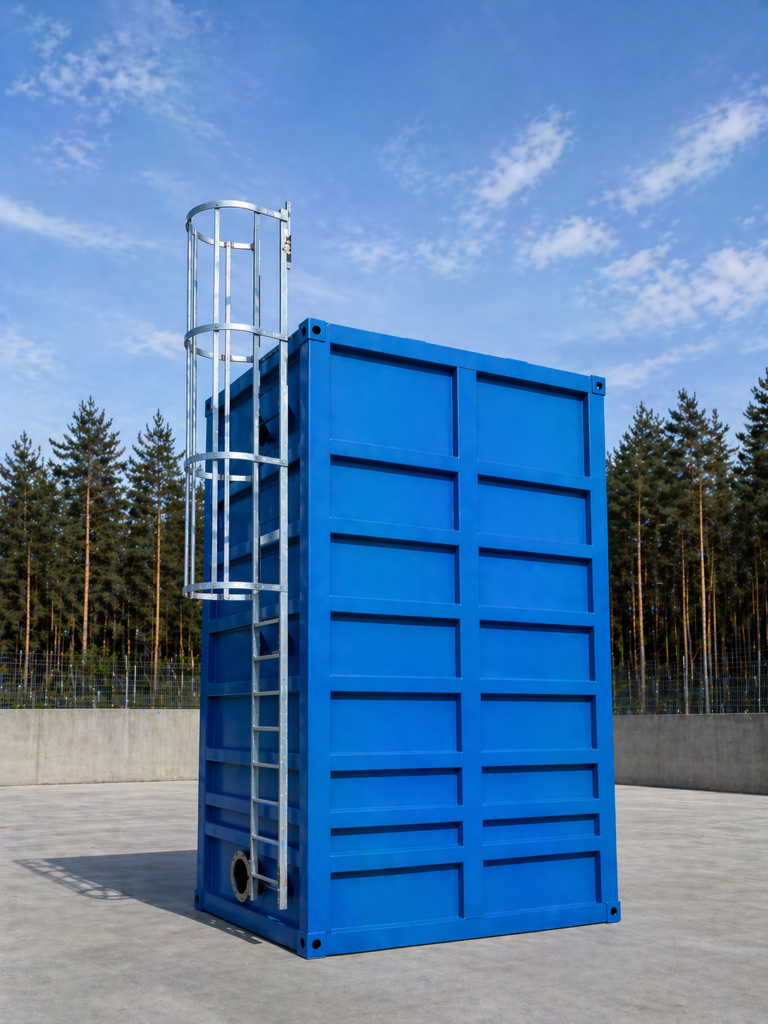
The Blue Foot Box exemplifies this approach. Designed as a reimagined containerised solution, it allows for increased module stacking and improved internal configuration,
delivering scalable treatment capacity of up to 1,200 cubic m per day within a compact footprint of approximately
7.5 sq m. This balance of high
capacity and minimal space reflects the direction in which decentralised systems are evolving.
A key factor in this progress is
the ability to maximise treatment capacity within physical and logistical constraints. By rethinking
conventional container formats and optimising internal architecture, modern systems can achieve higher membrane density and improved process efficiency. This not only
enhances performance per unit footprint but also reduces the number of units required on site, contributing to cost efficiency and simplified project delivery.
Equally important is the simplification of installation and operation. By reducing system interfaces to four primary process connections — air, permeate/backwash, sludge inlet and sludge outlet — the design minimises on-site complexity. Standardised
components, integrated headers and a pre-engineered modular approach enable faster commissioning and more predictable project execution.
This emphasis on simplicity is
increasingly critical. In many projects, timelines and execution risks are as important as technical performance.
Solutions that reduce civil works, streamline permitting and enable faster approvals — while limiting installation steps and allowing rapid start-up — offer clear advantages in both cost control and operational readiness.
Scalability is another defining
feature. Modular configurations
allow capacity to be expanded over time, either within a single unit or by connecting multiple systems in parallel. This enables phased growth without redesign, making decentralised systems well suited to environments where demand
evolves.
Beyond operational benefits,
decentralised solutions also support broader sustainability goals. Localised treatment reduces the need for extensive distribution networks and enables water reuse at source, contributing to more circular water management practices. Their compact footprint further facilitates deployment in space-constrained environments, where permitting and site limitations might otherwise delay implementation.
As the water sector adapts to
changing demands, decentralised systems are expected to play an increasingly important role. Rather than replacing centralised
infrastructure, they complement it,
creating more flexible and resilient hybrid systems.
Innovations in modular design and system integration are accelerating this shift. Solutions such as the Blue Foot Box demonstrate how
decentralised treatment can combine performance, scalability and simplicity in a practical, deployable format. As these technologies mature, they are set to become an essential component of future-ready water infrastructure.