
Our CEO Shares the Origin Story of Blue Foot Membranes
Our CEO Stephan van Hoof shares our origin story on Antoine Walter’s Podcast “Don’t Waste”. Click below to watch the full video or read the transcript on this page.
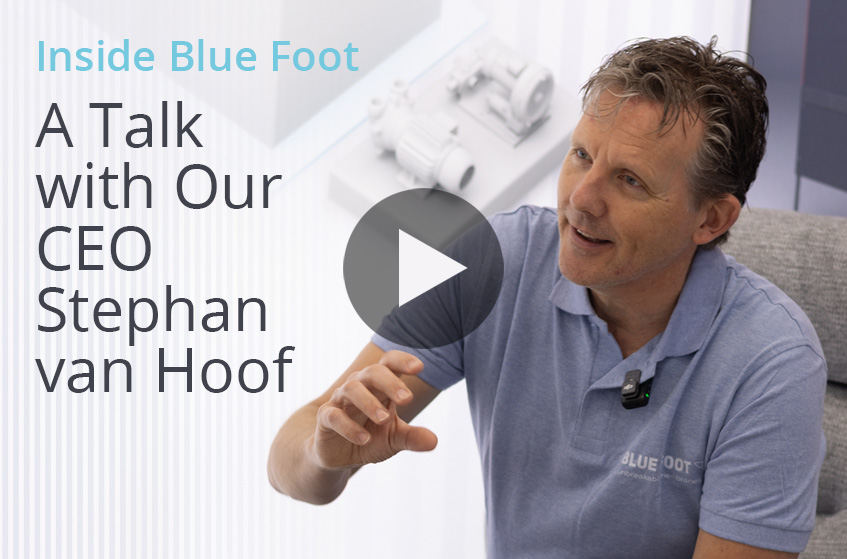
Transcript of the interview with Stephan van Hoof for the podcast “Don’t Waste”
Antoine: Bonjour and welcome to the Don’t Waste podcast. I’m your host Antoine Walter and in today’s episode I’m delighted to welcome Stephan van Hoof as my guest.
Stephan: Thank you for having me. I’m very happy to be here. I believe we first met two or three years ago at the conference.
Antoine: When you talk about MBR membranes, usually you have people saying flat sheets are the best, others say tubulars are best, and some say ceramics are best. If I get you right, you’re saying all of those have merits.
Stephan: We have all that. The trick is that we really combine the advantages of all of the above. It is based on a 3D textile on both sides of which we cast a membrane layer. The membrane layer is completely anchored into that textile. That means unlike run-of-the-mill flat sheet membranes which are often glued or spot welded to a backing plate our membrane is fully anchored and can be backwashed properly. We can apply pressure up to two bars in manufacturing tests to demonstrate robustness, though in process you don’t need that because permeability is so high.
Antoine: So you have a membrane in flat sheet form that behaves like a capillary submerged membrane. That already merges two form factors. And you claim robustness comparable to ceramics while retaining flexibility.
Stephan: Exactly. We combine the best of flat sheet, tubular and ceramic worlds into one membrane. The benefit for customers is clear: because we can backwash, we keep membranes cleaner, run at higher fluxes than typical flat sheets, and offer a compact system membranes can be stacked leading to smaller footprints, lower CAPEX and lower aeration rates. Lower aeration means lower energy costs and lower CO2 emissions. Operational flexibility is improved, including better peak flow handling.
Antoine: Give me a one-sentence elevator pitch for Blue Foot.
Stephan: It is the critical ingredient for any wastewater treatment plant based on membrane bioreactors: we provide the most robust and reliable membrane combined with the lowest total cost of ownership.
Antoine: You said “reliable” and earlier “unbreakable.” Is there a difference?
Stephan: They’re intertwined. Robustness makes the membrane reliable. Things will go wrong in plants you don’t know when and the key is how you recover. Our membrane’s durability and cleanability help plants recover and keep operating.
Antoine: You have a 30-year personal membrane story. You joined Blue Foot in 2020. Tell me about that journey.
Stephan: I first worked with the technology around 2015 16 when VITO was considering a spin-out. I did some technical work for them and was impressed. Later, they spun out Blue Foot and after several years and some references, the shareholders reached out in 2020 to take the next step. I joined because I like being between technology and commercial sides and building something bigger from a small team.
Antoine: How big was the team when you joined?
Stephan: Including production it was 11 people, but there was already a production muscle not just lab-scale.
Antoine: What was the first thing you changed?
Stephan: I changed the commercial strategy. The original plan of using distributors didn’t work for membranes. We adopted a clean OEM strategy and focused on building OEM partnerships and implementation know-how. A membrane is not a box; you cannot just ship it and hope it works. You need to provide implementation support, technical training, process descriptions, control philosophies and be part of the same team with OEMs and end users.
Antoine: How do you set boundaries between simply selling membranes and providing implementation support?
Stephan: We aim to provide implementation know-how and form partnerships where we engage technically with OEMs. For guarantees like our 50% lower energy claim, we define clear envelopes of conditions if partners follow our design and process guidance, we can stand behind guarantees. It’s project-by-project; exclusivity can be negotiated but it’s a two-way street.
Antoine: How do you expand geographically?
Stephan: Opportunistically. Our presence in Southeast Asia grew from a local relationship that developed into references. We opened an office in Singapore to support customers. We expand by building sales organization and local presence where we already have references.
Antoine: You claim 50% energy reduction over conventional flat sheets. How did you arrive at that number?
Stephan: The 50% baseline is a comparison to classical flat sheet membranes. Because we can stack modules and operate at lower aeration rates sometimes about 50% or even lower that reduces energy. We’ve also done a TCO study over 10 years where we won on total cost of ownership largely due to lower aeration.
Antoine: Are you past the pilot phase? Do you still need pilots for every project?
Stephan: For the vast majority of our applications mainly industrial we are past needing pilots for every project. Industrial customers are pragmatic and once partners and references exist you can reuse data across projects. However, some customers still want their own pilots; we can do that.
Antoine: Have you ever heard of a membrane that refuses to break?
Stephan: That’s the Blue Foot claim: our membranes have been tested; even if you pull and twist, they hold strong. It’s not only about membranes but the team and purpose behind it.
Antoine: Do you sell to end customers directly?
Stephan: No we have a transparent 100% OEM strategy. We reach out to end customers to make them aware, and then introduce an OEM partner for implementation.
Antoine: What types of projects do you focus on?
Stephan: Four types: greenfield builds, refurbishments of conventional treatment plants into MBRs (bolt-on solutions), replacement of membranes in existing MBRs, and mobile wastewater treatment solutions. Refurbishments are very interesting because many plants have usable concrete tanks; converting them to MBRs for reuse is very relevant.
Antoine: You raised €15 million in two tranches in 2023. The plan targets €40 million revenue by 2028 from about €5 million today. How realistic is that growth?
Stephan: It is ambitious and challenging. We chose to raise capital to accelerate sales, expand manufacturing, invest in pilots and grow the sales team. With OEMs and partner pipeline, we believe potential exists. We are investing in automated and robotized manufacturing, improving quality, delivery and cost. Manufacturing expansion is expected live end of Q3 to early Q4 this year.
Antoine: What’s your long-term goal scale-up then stay independent or become part of a bigger group?
Stephan: Right now I prefer hands-free growth without strategic investors that could restrict us. I have doubts about consolidation because it can suffocate innovative companies. The future is unclear; we’ll see.
Antoine: What needs to happen in the next 12 months?
Stephan: Set up partnerships, expand the sales organization, work with existing partners on projects, and expand and automate manufacturing.
Rapid Fire
Antoine: What is the toughest challenge for a tech startup?
Stephan: Inertia. The water sector is slow to adopt despite huge pressures. Many projects are permit-driven and delayed.
Antoine: Your best single piece of advice for founders?
Stephan: Never give up but also be realistic: if the economic model won’t work, don’t continue.
Antoine: What do you wish more investors knew about the water sector?
Stephan: Many investors lack intimate knowledge of the water sector dynamics. It is not SaaS; it is project-driven with different growth dynamics and delays. Investors should be prepared for that.
Antoine: Most unexpected partnership and what it brought?
Stephan: One partner who adopted the technology quicker than expected after data and pilots. Seeing an operator call and report that after cleaning the system ran again those moments are magical.
Antoine: What’s the profile you most admire and just hired for CCO?
Stephan: Chris King, our CCO; sector experience is important, especially membranes and OEM partnership settings. We look for people with water sector and membrane experience, agile and open-minded.
Antoine: What’s the tool you cannot live without?
Stephan: Our technical capability the ability to work with customers on implementation and process details.
Antoine: What’s the single insight your ideal customer needs to hear now?
Stephan: Water is your license to operate. Water reuse is key and MBRs are a very good solution. We provide a robust, reliable solution with low TCO.
Antoine: Stephan, thanks a lot for taking the time.
Stephan: Thank you for having me. I really enjoyed it.